DISAPPEARING CORALS
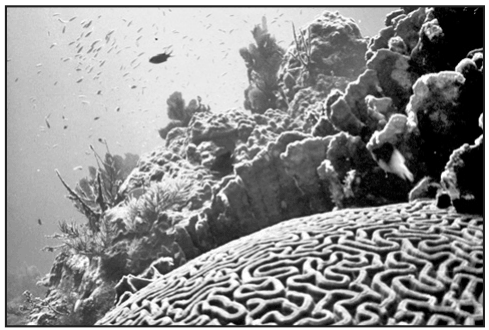
The deep blue waters of the Red Sea, the Caribbean Sea and the South Pacific Ocean attract divers and other tourists from around the world. They come to see the amazing coral reefs and the many different kinds of fish which live among them.(lines 1–4)
So, what are corals? They are actually various types of small living sea creatures. Some corals become very hard, like stones, and others stay soft. When many of the different kinds of corals come together, coral reefs are created. These fascinating reefs attract not only human divers but also twenty-five percent of the world's different sea creatures. They live among the corals, where they are protected from danger.(lines 5–9)
Today, the survival of the coral reefs is threatened for various reasons. One reason is that farms and factories use chemicals which pollute the oceans and poison all sea-life, including the corals. Also, ocean temperatures are rising because of climate change, which affects the corals as well. In addition, building hotels near the coasts for the tourists, making souvenirs from corals and too much fishing are all destroying the reefs. For example, Australia's Great Barrier Reef, which is about 2,300 km long, lost half of its coral between 1986 and 2012.(lines 10–15)
The disappearance of the reefs creates other problems. Without the reefs, other sea-life will disappear too. This will affect over 500 million people who depend on the corals and the sea-life among them for food and jobs. If the source of food and jobs of so many people is lost, the result will be hunger, poverty and serious political problems. Therefore, protecting the reefs is very important.(lines 16–19)
We can take action by trying to prevent pollution. For example, walking instead of driving and using fewer chemicals will benefit the environment everywhere, including the corals. So, our choices can preserve the coral reefs for ourselves and for future generations.(lines 20–22)